
The Space Rocks of California
Plus a veggie-shaped carousel in Milan, reading outdoors in Seoul, and more...

This week on The Escapologist…
Right Now in Travel, as Briefly as Possible
The Space Rocks of California
Right Now in Travel, as Briefly as Possible
It’s Milan Design Week and you have got to see this carousel by artist Laila Gohar that, instead of horses, has carriages in the shape of fruits and veggies. It’s on display this week at the Giardino delle Arti. (Milan Design Week, *Wallpaper)
Frank Lloyd Wright’s Fallingwater, one of the architect’s most famous works, has reopened after three years of major restoration. The former private home in Mill Run, Pennsylvania, celebrates its 90th anniversary this year and is designated as a UNESCO World Heritage site. (Arch Daily)
Seoul’s annual Outdoor Library program, which encourages reading in urban spaces, kicks off this week. Comfy seating, books to borrow, and literary events in sites across the city will mark the occasion. (Seoul Metropolitan Government)
There is so much destructive legislation – pending and active – impacting US national parks and public lands right now. Know that these policies are unpopular, and talking to your reps makes a difference. Something else you can do: One major issue has been the removal and alteration of signage at national park sites, particularly signs describing civil rights history and climate change. A grass roots effort called Save Our Signs (SOS) is working to map and document these changes. You can join them.
Has World Cup fever gone bust? In a report by the Financial Times, expected hotel demand for the World Cup has not yet materialized, even in big cities like New York. With jet fuel prices surging and Anti-American sentiment overseas impacting overall travel into the US, I am unshocked. (The Independent)

The Space Rocks of California
This is the second in a four-part series of shorts I wrote about Los Angeles in the pandemic. The first is Up, Up, and Over California.


The meteorites are in a room in the Geology building at UCLA in Westwood and I pay $9 for parking in a visitor’s garage, worried that I’m in the wrong spot.
Flash forward to a bad thought. Mental image of my rental Nissan being towed to the wilds of somewhere. A day’s worth of retrieving it.
I leave the garage and cross the street and try the doors of the Geology building and they are all locked. A digital keypad blinks at the side of each one, an ominous black rectangle with a red blinking light.
I make a slow lap around the building, trying every door. The web site says it’s open to the public. So it is. It must be. I am trying my fourth or fifth door when a voice behind me says,”Do you have a key to this building?”
“No,” I say. “Do you?”
He’s youngish, bespectacled, black-masked, wearing a backpack and holding onto some kind of metal sieve or strainer. It never occurs to me to ask him what it’s for. He pauses for a moment.
“Hold on,” he says. “I might know a way in.”
I follow a few steps behind and he introduces himself, makes small talk, and I tell him that I’m not a student. I’m a tourist. I came out of curiosity. He tells me then that he’s sort of between being a post-doc and a faculty member. I don’t ask questions about this.
He leads me under a concrete entry into what seems like a service entrance. There’s stuff around — buckets, sacks of what look like dirt. The detritus of construction. There’s a door that’s been propped open.
He leads me in and down white hallways lit with unseen fluorescent bulbs, up a flight of stairs. It attaches to a memory — the formality and insulation of academia. This quiet, the gleam of linoleum floors, in the middle of Los Angeles. I have not lived in this world for a long time, a space where all I had to do was learn things.
The man asks about New York and he tells me that his girlfriend grew up in Brooklyn — she misses the food.
Up two flights of stairs and it’s right there, with a sign on the door. We step in and a young woman, a student, surely, says, “Welcome! It’s the first day we’ve been open in two years!”
I read this on the web site, but I didn’t quite register. Closed for two years, this small room with its glass cases and pedestals, its explanatory dioramas.
It is a room full of rocks. Some of them are just out in the open, unprotected, with magnets stuck to them.
There are two men in the room who seem to be professors — both of them bespectacled, baseball hatted. One of them removes a magnet from the rock and taps the side of it against one of the meteorites. It is an abstract lump of a thing, no bigger than the air conditioner balanced precariously out the window in a New York City studio. The accompanying plaque says it weighs 800 pounds.
“Listen to how they sound.”
The rock sings, a pure kind of ringing. A temple bell. He takes the same magnet and reaches over to another meteorite. A different kind of ping.
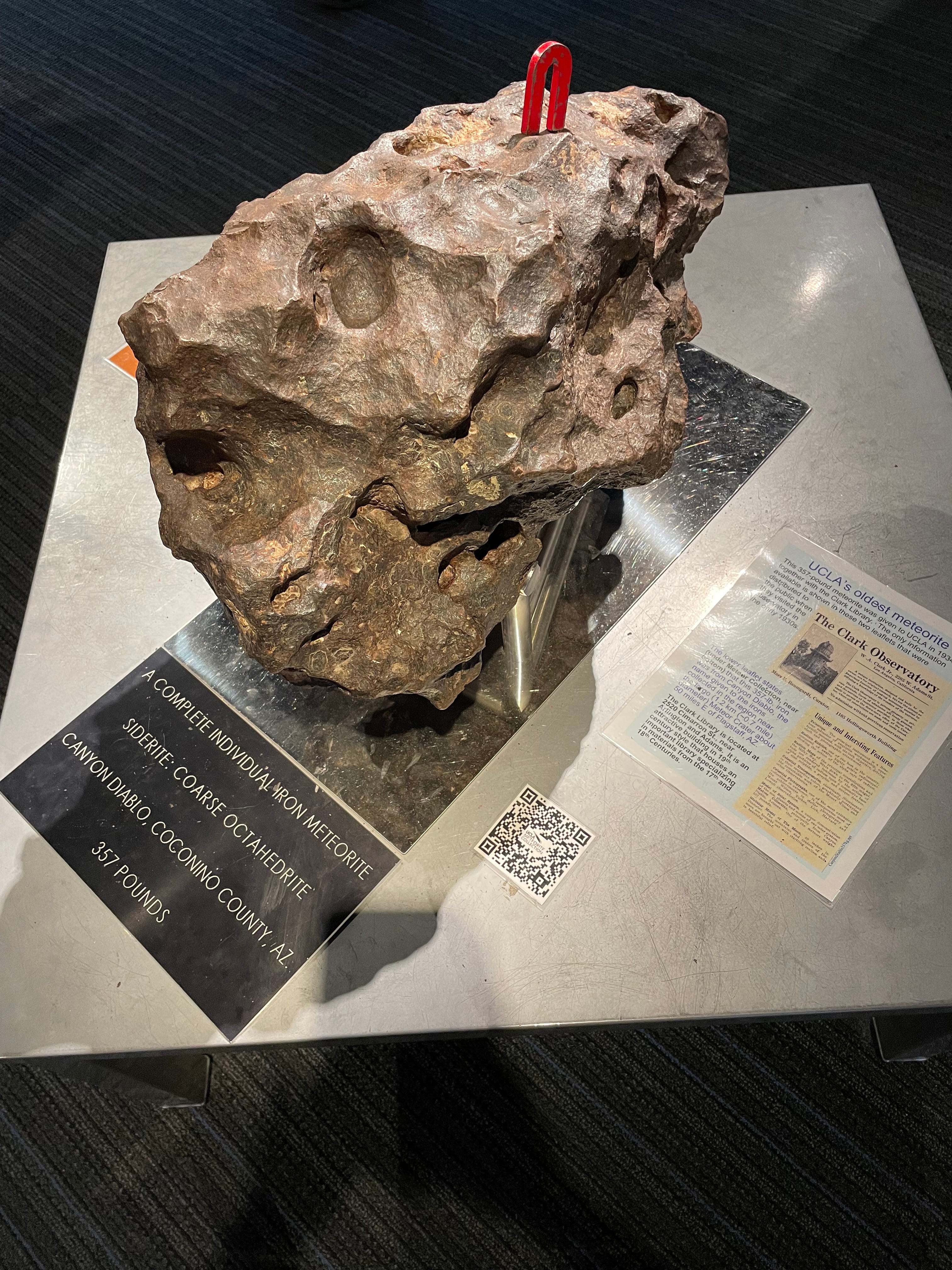
As I make a slow rotation around the room, I see rocks from the moon. I see slices of steel etched with little cross-hatched lines, as coolly symmetrical as modern art. I see a shelf of fakes, accompanied by an explanation: people reach out to UCLA with rocks all the time, thinking they’re meteorites. Only about 1% of them end up being authentic.
All the while, the other professor is talking to the young woman — the one who greeted me. He’s explaining to her how the university came by its specimens.
“The Smithsonian,” he huffs, “They don’t pay for anything! Not even a finders fee!”
She nods and murmurs an occasional, “Oh wow,” as he tells her about the discovery of some of the rocks in the room, and I can feel her brain working. She’s interested, but cognizant of being mansplained to. The wows, the audible equivalent of nodding and smiling.
“The irons, most of the biggest ones are in Washington or Chicago or New York.”
I like this, how he calls them irons. Like golf clubs. Or when people who know about aviation call airplanes “metal.” That sense of weight hurling through space.
In a case of rocks from Mars, someone has added a little plastic figurine of Marvin the Martian.
I sign the guestbook. I use the ladies room. I have trouble getting out, down those same corridors again. Just outside the meteorite room, there is a magnificent T-Rex skull and I am amused by the juxtaposition of the two things — prehistoric victim and celestial murder weapon in the same hallway for eternity.
The not-post-doc guy has disappeared, so I let myself out, unable to backtrack to the same way I got in. I break into the late afternoon light and it’s all green and brick. There are people walking around. Students who look so young. People in medical scrubs and lab coats.
I duck back into the darkness of the parking garage. The car is fine in its small space. No tickets. It’s still there.
I Google places for dinner, and speed away.
This carousel is very Harry Styles coded.
I took an Earthquakes class in the same building! I’m pretty sure I’ve been to that museum and it was just as confusing to get to back in the day lol