I Can’t Speak Italian and Other Tragedies
A week in Olympic Milan and a lifetime trying to understand my father's homeland...
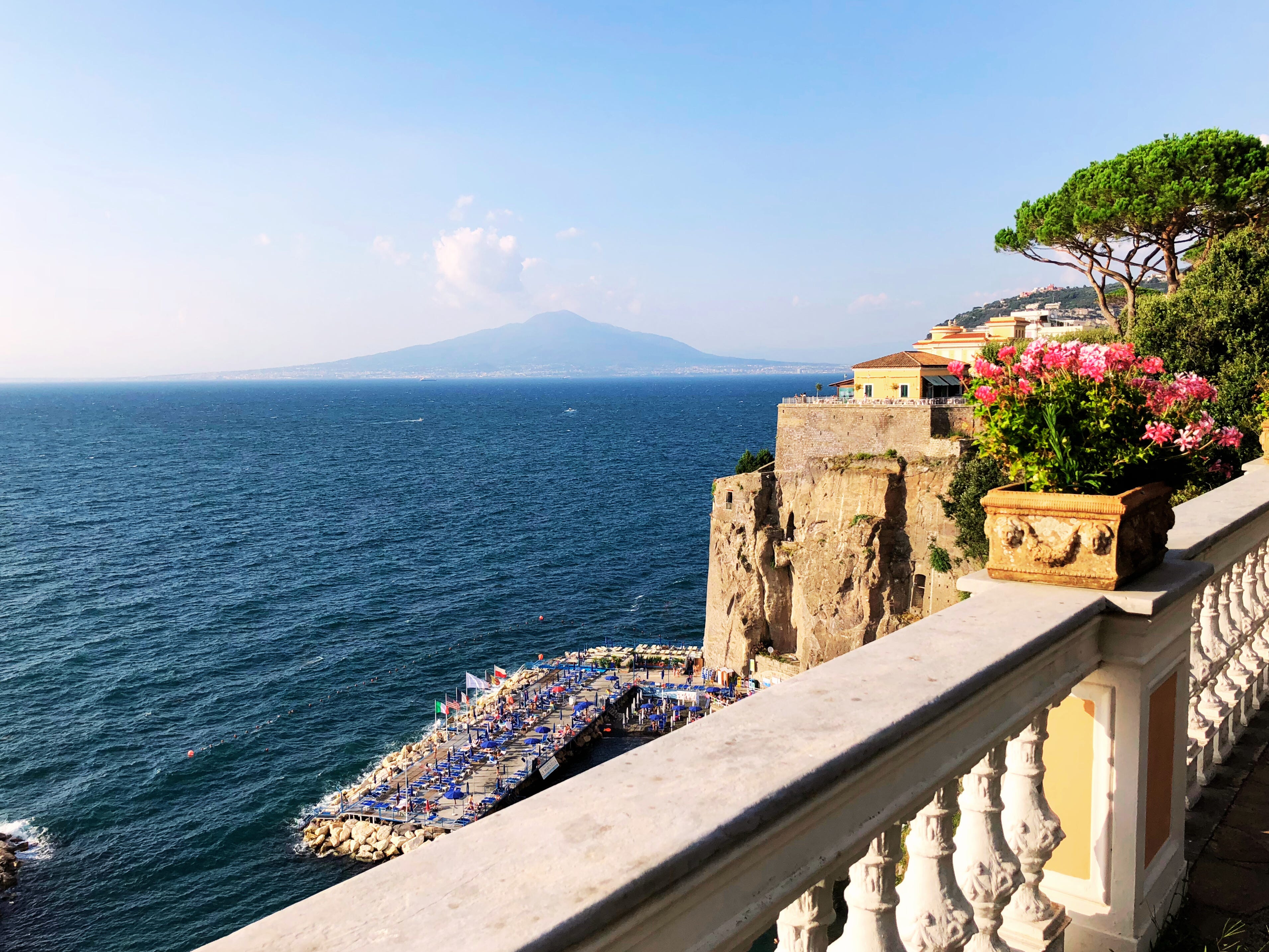
I was in Sorrento and it was one of those summer days that feels like what people think the Amalfi coast feels like. Cloudless, a little too warm in a way that feels sexy and not gross. Sparkling Mediterranean, lemon granita, sandals on cobblestones, a pale blue skirt.
I was walking near that seaside area that’s very touristy, right up on the cliff near the park where people watch those eye-popping Sorrento sunsets. These sunsets never photograph well. You cannot take them home. I was free. I was jobless, partnerless, riding 12-hour ferries around the region with a half-dozen tank tops in an oversize suitcase and not much else. I had no idea what would come next in my life, I was running out of money, and I had never been happier.
A man appeared next to me, matching my stride. I had no idea where he came from. His approach was stealth, quick. He spoke in broken English. Where was I going? What was my name? The usual.
If this happened later in my life, I would have smiled and waved and walked away. Have a nice life, man who is up to no good. But it was that kind of cloudless day and I had no plans. I was also in a time of life where I was more willing to entertain this sort of thing. I responded.
I said to him, in Italian, “You don’t have to speak English. I understand Italian.”
He was taken aback. This was not part of his plan.
“How do you speak Italian?” he asked, in Italian now, perplexed but undaunted.
So I told him the truth. “Mio papa viene di Catania.”
My father is from Catania. My father is Sicilian.
I have never seen a man disappear so quickly. He dissipated, absorbed into spacetime. Later, I would tell my friends, if you ever need to get away from a pest of a man in Italy, try this one amazing trick.
My father was a quiet, bookish man. He would no more fight this guy than he would skip pasta on Sunday, but I was grateful for the protective illusion, whatever it meant.
On other trips to Italy, before and after, I always spoke of my father. It was an easy way in, a place to start a conversation with a stranger in another country. A way to share a few words of Italian, to bridge a gap. Plus, I liked the story of my family, of the strange way I speak. To Italians, it made me an odd curiosity – a child of the diaspora who can barely choke out a few sentences of proper Italian, but who can grasp Sicilian well enough to gossip with anyone’s great-grandmother. Italians found it bizarre, funny. It was a paradox to them – so many people left Italy to seek wealth and opportunity in the United States only to have their children and grandchildren return to the motherland speaking the language of paupers.
When I first encountered this dissonance in Italy, I thought Italians were making fun of me and it brought me great shame. I wanted to speak their language properly. I was a journalist. I was educated. I could understand every word they said. But when I opened my mouth to join the conversation, my lizard brain reverted to the vocabulary I learned at home with my grandmother, my aunts, my father.


The Italian word for artichoke is carciofo, but if I were to use it in conversation, the word that immediately rises to the top of my consciousness is caccociula, the Sicilian word. The first word, for me, conjures a spiny vegetable in a still life, bright green hard as a brick. The second word is my grandmother’s artichokes, which she steamed and then roasted in the oven until the leaves were black as coals, gobs of garlic and fresh parsley and parmesan wedged between them. I can say the first word, but I can’t quickly remember it. Only the second one sticks, not just because I can remember it, but because I can feel it.
For me, this makes speaking Italian really difficult. I use the “wrong” words, that is to say, the Sicilian words, all the time. You can also understand how bizarre this must sound to an Italian speaker, who can usually suss out what I mean but only after a moment of realization – a wry smile, a nod of understanding. Their amusement, I know, is not meanspirited. It is curiosity. It is also a keen awareness about Americans. About the Italian south. About immigration. About wealth distribution and the ironies of privilege. I try to remind myself that it is very Italian to always be rolling your eyes a bit, to feel the absurdity of the everyday, even when you’re just ordering coffee. I know this not just because I can observe it, but because I do it. It is part of me in the same way my grandmother’s artichokes are – an instinct more than an idea.
I didn’t try to speak Italian very much on this trip. It’s tiring, for one thing, to manually choose your words one at a time, like digging in a box of chocolates for the best flavors. But also I did not want to talk about my father. I did not want to articulate the words that I know in Italian and Sicilian, because it’s almost the same in both languages. A quirk of pronunciation.
É morto. É mortu.
Saying it in his language makes it feel like he died twice.
I did not want to have the conversation – or even share the information – with strangers in a language where I struggle to articulate nuance. (Of course, I say this as though I can articulate the nuances of the loss of my father in English, which I also can’t do.) It felt too close and I felt underequipped. It was like I had lost my way, wandered off the trail that connected me to not just my father’s culture, but to my father himself.
I am hopeful for a way back. Maybe I will need to get closer to his hometown, to the places he saw and knew. For now, I am not ready to summon him, or the idea of him, as a charm or a protection. The ghouls will not vanish if I mention his name. The door stays closed. For now – I hope not forever – his Italy is only mine.
Coming Soon
A future edition of this newsletter will cover all of the mistakes I made on my Olympic trip to Milan. Because there is no such thing as travel where nothing gets messed up.
I’m thinking of leading a little seminar on travel journaling and preserving your travel memories. If that sounds like something you’d be interested in, please drop a comment below or shoot me a note.
A foolproof Milan capsule wardrobe that’s comfortable and won’t make you feel like a tragic American.


