Elvis Is Buried by the Pool and Other Ghost Stories
Plus a quickie guide for where to buy NYC-themed holiday gifts that don't suck
Here’s a smattering of things that have caught my attention lately…
Stahl House Is for Sale
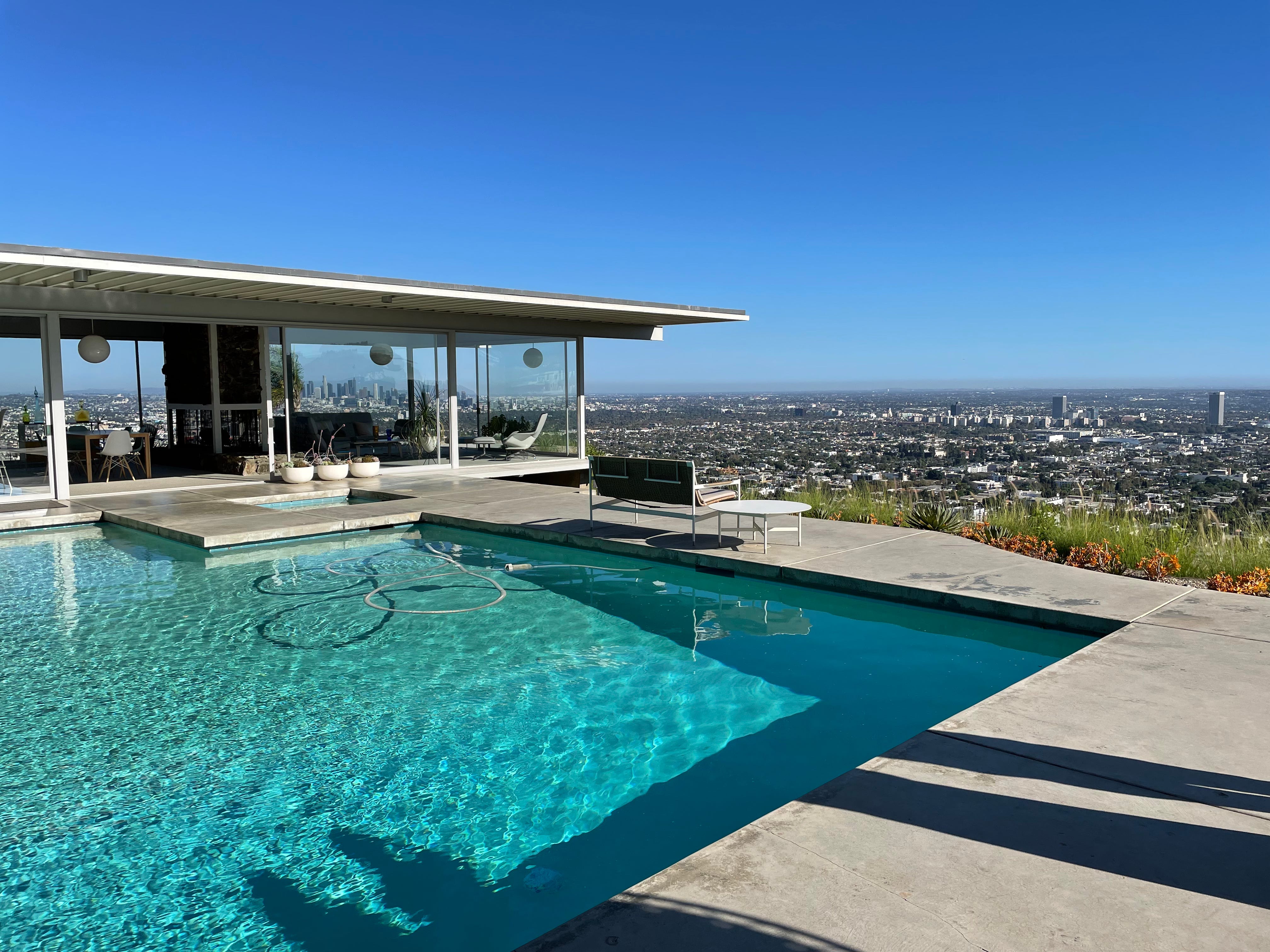
Perched in the Hollywood Hills overlooking Sunset Boulevard, you’ll find Stahl House – a masterpiece of American architecture. Designed for the Stahl family by Pierre Koenig on a lot that was considered impossible to build on, it was completed in 1960 and is a fever dream of Midcentury Modern design.
Its angular swimming pool and glass living room overhang a ridge, creating a sense of weightlessness. Views stretch from the mountains to the hazy skyscrapers of downtown. My favorite detail, however, is the family’s original wall covering in the bathroom – lime green shag carpet, accented with framed, embroidered pictures of house plants.
Details like this remain in place because the home has been continuously owned by the Stahl family since its construction. Its preservation, for them, has been personal; the home was occupied by the family until 2007. They’ve listed it for $25,000,000 and have been clear that they aren’t just looking for a buyer, but a steward who will preserve the home’s legacy.
Stahl House is number 22 in the series of “Case Study Houses” commissioned by Arts & Architecture magazine after World War II. The initiative challenged architects to design affordable, efficient homes that would address the postwar housing boom.
The idea of a magazine sponsoring this kind of contest today seems impossible — a relic of a media industry that’s devolved beyond recognition. Equally difficult to imagine — the cost of the home back then was $37,500, or the equivalent of $398,600 in 2024. That’s below the current median American home price ($410,000-$440,000), so affordability truly was part of the assignment and not a dim idea of what was aspirationally affordable — a perspective that seems to be the norm in whatever house magazines (I suppose I should call them “shelter publications?”) still exist.
The home is and has been open for public tours for years. (It is among the best of its kind I’ve ever taken.) But news of the home’s sale seems to have amped up demand. On the web site, tours are sold out through February of 2026 and March dates have not been released yet. Though other Case Study Homes still exist, only a few are open to the public. Here’s hoping that the new owners of Stahl House continue that tradition as well.


If you’re looking for another excellent residential architecture tour in Los Angeles while Stahl House is in flux, I highly recommend Schindler House. Though it’s quite different than Stahl House – it was built in 1922 and represents America’s full tilt into Modernism – it is beautifully preserved by the MAK Center for Art and Architecture. Tours are readily available, affordable, and easy to book online.
Hello Hotel Dolly
I was just in Nashville and people in town were talking about Dolly Parton’s Songteller Hotel, which is slated to open next year just around the corner from Ryman Auditorium. It’s Dolly’s first officially branded hotel in the city. In the renderings it looks cute – pink and spangly but not aggressively so, with a lobby space that looks like the shimmering underside of a jellyfish. A museum space that showcases Dolly’s costumes and memorabilia is also in the plan.


As surprising as it is that there’s never been an official Dolly Parton hotel in Nashville, it’s unsurprising that there’s a very fun, unofficial version already in the market. The Graduate Hotel near Vanderbilt University showed no such restraint in its use of pink and has been a magnet for bachelorette parties and bridal showers since it opened in 2019. Its rooftop bar and restaurant, White Limozeen, is named for the eponymous 1989 Dolly album. At one point, there was and may still be a five-foot, raspberry-hued bust of Dolly by the rooftop pool. The allusions and the decor are not subtle.
Given that The Graduate Hotel always seems packed – that goes double for White Limozeen, where I failed at snagging even a single bar seat for brunch – the success of The Songteller seems like a foregone conclusion. It’s tailor-made for the bachelorette party crowd and, after all, they’re the ones who run this town.
If you can’t wait for the hotel opening and want a glimpse at a fabulous collection of Dolly’s stuff, the Country Music Hall of Fame and Museum’s exhibit, Dolly Parton: Journey of a Seeker, runs through September, 2026.
A Tale of Two Studio Bs


If I had a buck for every time I visited a renowned American recording studio in a single month, I’d have two bucks, which ultimately doesn’t buy much but I do get to tell this story. One was RCA Studio B on Nashville’s Music Row. The other was Prince’s Paisley Park, just outside of Minneapolis.
These two spots, sacred to popular music in their own ways, look entirely different. Studio B in Nashville is the room where Elvis, Roy Orbison, Dolly Parton, Willie Nelson, Waylon Jennings, and dozens of others recorded their hits. It is a bit yellowed and water-stained in places and looks much as it did in the 1950s. A guide guessed that only the ceiling lights, which were installed to better facilitate public tours, have been added since the studio’s founding. A cabinet door with a missing panel is a longstanding tribute to Elvis, who broke it during one of his sessions. The studio retains its checked linoleum floor, its pockmarked soundproofing panels. A crisscross of black electrical tape marks “The Sweet Spot,” where singers stood for the best vocal quality.
Nearly a thousand miles north, Paisley Park sits perched on a hill in the Minneapolis suburb of Chanhassen looking blocky and featureless as a corporate headquarters – which, for Prince, it of course was. This was Prince’s home and his musical playground, the place where he wrote and produced his own albums, as well as those for other artists. It looks like the late 1980s – neon colored and heavily patterned, with gold and platinum discs lined up on the walls like sets of gleaming teeth. The ceiling is painted in a blue skyscape of clouds. In the atrium, you will hear Majesty and Divinity, doves that serve as the home’s unofficial mascots, cooing from their enclosure on the mezzanine level.
Security is tight and heavily enforced. There is a strict no-photos policy and all devices, including smartwatches, must be secured in locked pouches for most of the tour. This seems, somehow, in keeping with Prince’s elusive nature but also, a gesture of respect. Prince didn’t just live at Paisley Park, he also died here in 2016.
These worlds – the creative spaces that built legendary people and sounds – feel caught in time. They are spooky – empty and quiet but also spirits seem to lurk everywhere. You can almost hear the chaos when the toe of Elvis’s boot went through that cabinet. You can imagine Prince walking through a control room door, black bass guitar slung over his shoulder. It seems as though these things could happen at any moment, while you’re standing there or an instant after you leave. On tours of these spaces, guides will play the songs that were dreamed up in those rooms and time slips again, but in a different way. Music and place fall in rhythm but you, the listener, are all wrong. It’s not you who should be there, but you’re the one who is.
RCA Studio B in Nashville is run by the Country Music Hall of Fame and Museum, and tours can only be booked in tandem with museum tickets. (Book well in advance for studio tours. They fill up fast.)
Paisley Park tours vary in length and focus, depending on your level of Prince fandom. When it first opened as a museum, Paisley Park was managed by the same company that manages Graceland, Elvis’s home in Memphis. (It’s currently run by several arms of Prince’s estate.)
Graceland is another musical landmark that punches well above its weight as a place to visit, even if you’re not the biggest Elvis fan. (Did you know he’s buried right next to the pool? He is.)
NYC Museum and Cultural Institution Gift Shops for When MoMA Design Store Is Packed:
The shop at the New York Historical Society. The cafe also has nice coffee and pastries.
The New York Public Library Shop. Stuff about books! Stuff about New York!
The Whitney Shop. Lots of books that are tough to decipher without an art degree, but also very cute items for kids and art-loving normies.
The Morgan Shop. More fun in person than online (everything is?), but delightful Victoriana and stationery.


Great curation of hauted spaces and time capsules. The observation about Studio B and Paisley Park as spooky because they feel both emtpy and inhabitated at the same time nails something about preserved creative spaces. Loved the aside about the Case Study House initiative, the idea of a magazine commissioning architecure feels impossibly ambitious now. Kinda makes you wonder what equivalent institutional support for public-interest design even exists today.